A community,
more than a century in the valley.
The Bahá'í community of Salt Lake City traces its roots to the earliest years of the Bahá'í Faith in America — three travelers, each carrying a new idea into a still-young state, between 1903 and 1906.
Today, Bahá'ís live across the Wasatch Front and the wider state. The local community here in Salt Lake is one of many — welcoming and at work alongside our neighbors.
- 1903
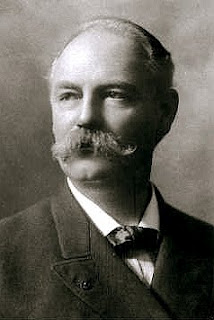
Thornton Chase visits Salt Lake.
Chase — the first American Bahá'í — passes through the valley, carrying the new teachings west. His visit marks the earliest known Bahá'í presence in Utah.
Thornton Chase, c. 1900 - 1905
Anna Woodward Copely settles in Salt Lake.
The first long-time Bahá'í resident of the city. Her home becomes a quiet gathering place for friends and inquirers.
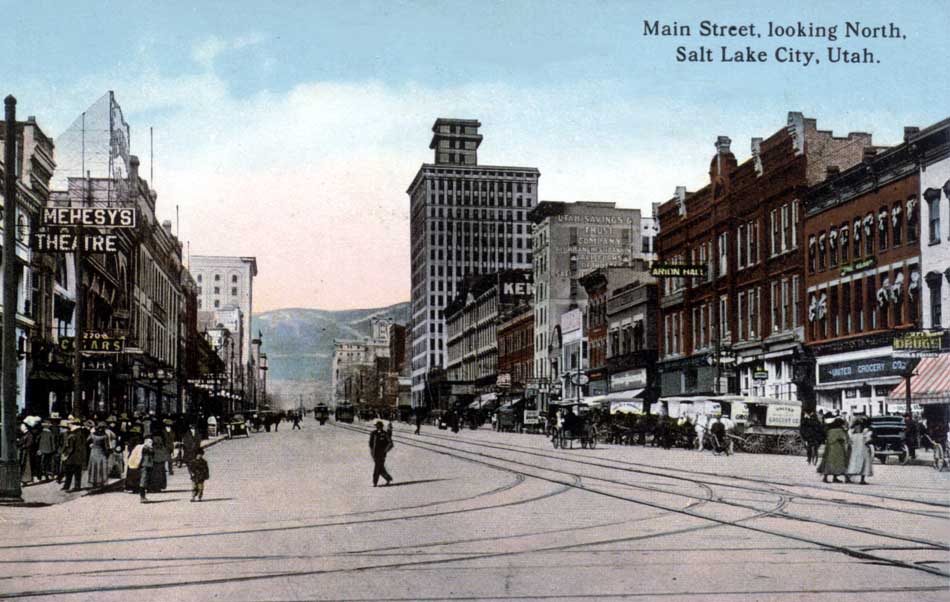
Main Street, Salt Lake City, 1890s - 1906
The Countess Aurelia S. Bethlen arrives.
A Hungarian noblewoman who had embraced the Bahá'í Faith only a few years earlier. Her travels through the West brought the teachings to a wider circle.
Main Street postcard, c. 1900 - 1912
‘Abdu'l-Bahá visits Salt Lake City.
The eldest son of Bahá'u'lláh — founder of the Bahá'í Faith — visits Salt Lake during his journey across North America. The visit is still remembered locally.
Union Pacific Depot, Salt Lake City


The well-being of mankind, its peace and security, are unattainable unless and until its unity is firmly established.
From ‘Abdu'l-Bahá's Paris Talks.
‘Abdu'l-Bahá (1844–1921) was the eldest son of Bahá'u'lláh and, after a lifetime of imprisonment and exile, the one entrusted to carry his father's teachings into the world. Between 1911 and 1913 he travelled across Europe and North America — through London, Paris, New York, Chicago, and as far west as Salt Lake City in the autumn of 1912 — giving public talks in churches, synagogues, universities, and union halls.
On the evening of 17 November 1912, at Genealogical Hall in New York , he laid out the central teachings of Bahá'u'lláh as a continuous list — what came to be known as the twelve principles. He called them the distinguishing characteristics of the age, not a creed to subscribe to but a starting point for thinking about how humanity might live together. Four of them are below, each linked to a Paris Talks address where ‘Abdu'l-Bahá developed the same idea at greater length.
The oneness of humanity
‘Abdu'l-Bahá taught that all people are leaves of one tree and branches of one origin — different in colour and culture, one in essence. The differences we inherit from history are real, but they are surface; beneath them runs a single human family. To live this truth is to refuse every line that divides one child of God from another.
Learn more →The equality of women and men
Women and men are created with equal rights and equal capacities — in religion, in society, in the life of the mind. ‘Abdu'l-Bahá insisted that a world taught and led by only half its members cannot rise, and that the education of girls is not a courtesy but a foundation. Until women and men walk together as full partners, humanity moves with one wing folded.
Learn more →The harmony of religion and science
Religion and science are the two wings by which the human spirit ascends. ‘Abdu'l-Bahá taught that a religion which contradicts reason is no longer religion — it has slid into superstition — and a science cut off from conscience can wound as easily as it heals. Truth is one; the heart and the mind are meant to find it together.
Learn more →Universal peace
‘Abdu'l-Bahá spoke of peace not as a sentiment but as a structure — a world in which the nations agree, through a supreme tribunal of their own making, to resolve their disputes by justice rather than by arms. Peace begins in the conscience of each person and in the welcome offered to a stranger, and it is completed in the institutions that bind humanity together. It is the work of our age, and it is achievable.
Learn more →More on what Bahá'ís believe.
Bahá'í communities across Utah.
Since those early years, dozens of Bahá'í communities have taken root across the Wasatch Front and the wider state — from the cities of the valley to the towns beyond. If you live outside Salt Lake City, there is almost certainly a community closer to you, and we'd be glad to help you find it.
Get in touch and we'll connect you →
The Salt Lake Tribune visited the local community.
A profile of the Bahá'í community in Salt Lake — its history, its quiet work, and how the local friends remember ‘Abdu'l-Bahá's 1912 visit.
Read the Tribune article →Want to learn more? Come join us.
Sunday gatherings, study circles, and children's classes are open to anyone.